The Evolution of Table Tennis Rubber and the Spin It Made Possible
See how table tennis rubber changed the racket’s grip, spin and control, and why each covering reshaped the shots players could create.
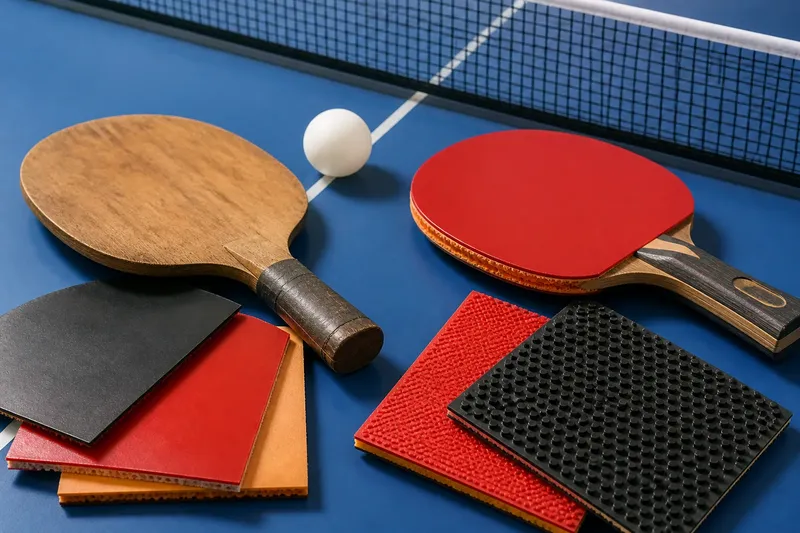
How did table tennis rubber change the shots players could produce? The history of table tennis rubber is a history of changing contact: a ball meeting bare wood, a thin covering, or a surface designed to grip and deform around it. Each change altered how readily a player could create spin, absorb an opponent’s pace, and keep a shot on the table.
From bare wood
Early table tennis rackets were often simple wooden paddles, sometimes covered with materials such as cork or cloth. Without a resilient, textured rubber surface, the ball tended to leave the racket with less added rotation. Players could still direct it, vary its pace, and use the angle of the paddle, but the range of spin-driven actions was limited.
That distinction matters because a table tennis ball does not respond only to where the racket points. A glancing contact can make it rotate, and that rotation affects its flight and bounce. A covering that grips the ball gives the player more opportunity to produce such contact; one that offers less grip makes the interaction more direct and less spin-oriented.
Early rubber coverings began changing the relationship between hand and ball. A sheet of rubber provided a more elastic and grippy surface than bare wood. The ball could stay in contact with the covering in a way that made brushing it—moving the racket across its surface rather than striking squarely—more useful. This opened greater scope for topspin, backspin, and sidespin.
Rubber meets sponge
A major shift came with the pairing of rubber and sponge. In this construction, a rubber sheet sits over a layer of foam-like sponge, which is attached to the racket blade. The sponge can compress when the ball arrives, then rebound as the ball leaves. That extra response changed both the speed available to attacking strokes and the feel of contact.
The effect depends on the whole construction, not sponge alone. A grippy outer sheet can catch the ball while the sponge deforms beneath it. Players can then combine a brushing action with a more forceful stroke, producing a ball that carries both speed and rotation. The same covering may also give a player more ways to vary the depth and pace of a return.
Sponge did not simply make every shot easier. A lively surface can send the ball away quickly, leaving less time for a player to adjust the racket angle. The added response can magnify small differences in contact, so a player must learn to judge the incoming spin and choose a suitable stroke. Equipment expanded what was possible while also making touch and timing more demanding.
Two rubber faces
As rubber technology developed, players could use different coverings on the two sides of a racket. A common arrangement paired a smooth, grippy surface with a pimpled one. “Pimples” are small raised projections on the rubber. They may face outward, touching the ball directly, or face inward beneath a smooth outer sheet.
Smooth, inward-facing pimple rubber became especially suited to creating spin because its outer surface could grip the ball across a broad contact area. Outward-facing pimples behaved differently: the ball met the raised points rather than a continuous smooth sheet. Depending on the design and the stroke, the contact could feel more direct, and the player might use the surface to block or disrupt an opponent’s rotation.
Having two faces introduced a tactical choice that was also an equipment choice. A player could use one side to generate heavy spin and the other to alter the return’s pace or response. Switching sides during a rally could make it harder for an opponent to read the racket’s effect from the stroke alone. The color difference used to distinguish the faces helped opponents identify which side was in play.
Grip and control
“Control” in table tennis is not a single property of rubber. It describes how predictably a player can direct the ball in a given situation. A grippy covering may make it easier to brush the ball and shape its rotation, but a highly responsive combination can also send a misjudged shot long. A less lively surface may reduce that rebound while changing how much spin a player can impart.
Consider an invented situation: a player using a soft, grippy covering faces a serve with backspin. If the player opens the racket angle and brushes upward, the covering can help produce a lifted return with topspin. If the same player closes the angle too much or makes a mistimed contact, the ball may catch the net or fly beyond the end line. The covering offers a wider set of possible contacts, not an automatic correction for poor timing.
Rubber also changed how players could manage an opponent’s spin. A player can absorb pace with a controlled block, redirect the ball, or counter with topspin. The surface influences how much the ball grips or slips at contact, while the blade, sponge, stroke, and incoming rotation all contribute to the result. No single layer explains the shot by itself.
Rules and standardization
As coverings became more varied, the game’s governing rules had to define what counted as an acceptable racket surface. Regulation has addressed matters such as the materials and arrangement of the covering, the requirement for distinct colors on the two sides, and restrictions on treatments that alter the playing surface. These boundaries help preserve the recognizability of a stroke and the opponent’s chance to respond.
The development of rubber is therefore not simply a march toward more grip or more speed. Equipment rules shape which kinds of surface effects can be used in competition. A change in what a covering is allowed to do can alter the balance between creating spin, returning it, and disguising the racket’s effect. For details that affect a particular competition, the current governing rules and the equipment maker’s instructions are the relevant references.
What changed over time
The broad progression is from a relatively direct contact with the ball toward coverings that let players shape contact more precisely. Rubber increased the scope for friction. Sponge added compression and rebound. Different pimple arrangements offered contrasting ways to grip, release, or redirect the ball. These changes did not replace technique; they gave technique more possible outcomes.
That history also explains why table tennis spin can be difficult to read. A stroke’s visible motion is only part of the information. The racket face, covering, and quality of contact help determine the ball’s rotation. A player watching the opponent’s arm and racket can make an informed guess, but the ball’s flight and bounce provide the clearest immediate evidence of what happened.
Questions about rubber?
Why does rubber create more spin?
A grippy rubber surface can hold the ball briefly enough for a brushing stroke to impart rotation. How much spin results depends on the contact, the racket’s movement, the surface, and the incoming ball.
What does sponge add?
Sponge compresses under impact and rebounds, changing the feel and speed of the racket’s response. It can support forceful spin strokes, but it also asks the player to manage a more responsive contact.
Why use different sides?
Different coverings can produce different kinds of contact, giving a player more than one way to attack, block, or disrupt spin. The opponent can see which side is used, but still has to interpret the stroke and ball.
Did rubber replace skill?
No. Rubber expanded the range of available spin and control, while making judgment of angle, timing, and incoming rotation central to using that range. The same surface can produce very different shots in different hands.
Reading the racket
When watching a rally, think of the covering as part of the contact rather than as a shortcut to a particular shot. A brush, a flat hit, and a compact block can produce different results even with the same rubber. The evolution of table tennis rubber matters because it multiplied those choices: players gained more ways to shape spin and control, and opponents gained more reasons to read the ball carefully.
One useful cue is the ball’s first bounce. A serve that kicks sideways or a return that dips sharply can reveal rotation that was hard to see at the racket. Follow that bounce alongside the player’s contact, and the equipment’s history becomes visible in the rally: not as a list of materials, but as a growing range of effects the players must create, recognize, and answer.