Offside Is Not the Same as Standing Beyond the Defence
Understand soccer offside position, active play and the referee’s decision so you can tell why a player beyond the defense may still be onside.
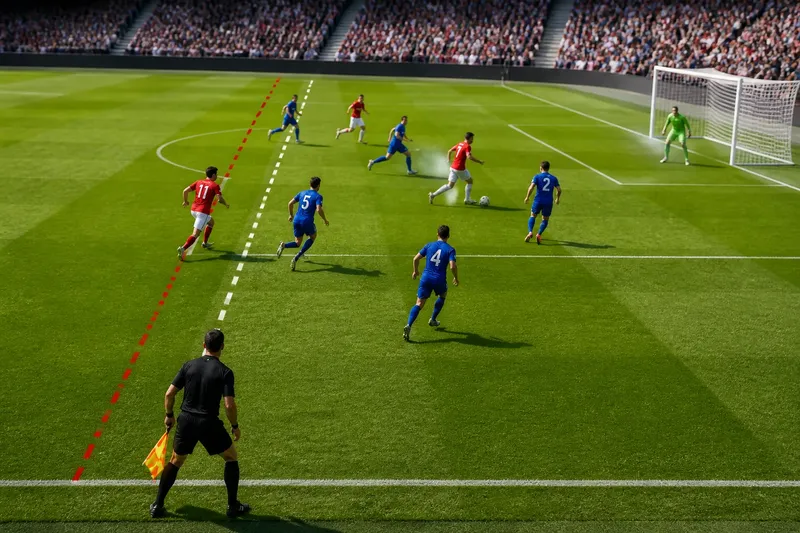
Why can a forward stand beyond the last defender without the referee calling offside? In soccer, offside position alone is not an offence: the player must also become involved in active play when a teammate plays or touches the ball. Keeping those two ideas separate makes the decision much easier to read.
Position at the pass
Offside is judged at the moment a teammate plays or touches the ball, not when the receiver gets it. A player is in an offside position if they are in the opponents’ half and nearer to the opponents’ goal line than both the ball and the second-last opponent. The goalkeeper counts as an opponent, but is not necessarily one of the two opponents closest to goal.
“Second-last opponent” is more useful than “last defender.” A goalkeeper may have left the goal area, or a defender may be behind the goalkeeper. The referee compares the attacker with the two opponents nearest the goal line, then checks the ball’s position. If the attacker is level with the second-last opponent or the ball, they are not in an offside position.
Arms and hands do not count when judging which player is nearer the goal line. For this purpose, the relevant parts of the body are those with which a player may legally play the ball, such as the head, torso and legs. The assistant referee tracks the players’ positions, while the referee decides whether an offence has occurred.
Position is not an offence
A player can be beyond the defensive line and still be legally placed there. The position becomes relevant only if that player is involved in active play after a teammate plays the ball. This distinction prevents the rule from treating mere location as wrongdoing.
Active play can involve playing or touching the ball, interfering with an opponent, or gaining an advantage from a rebound or deflection. These are separate ways an offside-positioned player may become part of the action. A forward who simply waits in an offside position while a teammate carries the ball does not commit an offence by standing there.
Say a forward is beyond the second-last opponent when a teammate passes sideways to another attacker, who then sends the ball back toward the forward. If the forward remains uninvolved until that later pass, the referee judges the position at the moment of the later pass. The original position does not by itself make the eventual reception offside; the forward’s position at the relevant touch and subsequent involvement are what matter.
Three routes into play
These questions help distinguish an offside position from an offence without treating every player near the goal as a violation.
What counts as playing the ball?
An offside-positioned player commits an offence by playing or touching the ball passed or touched by a teammate. The teammate’s touch sets the moment for judging position, while the receiver’s later contact establishes direct involvement.
How can a player interfere with an opponent?
A player can interfere by obstructing an opponent’s line of vision or by challenging an opponent for the ball. Simply being nearby is not automatically enough; the referee considers whether the player’s position or action actually affects an opponent’s ability to play.
What does gaining an advantage mean?
A player gains an advantage from an offside position by playing the ball after it rebounds or is deflected off an opponent, or after a deliberate save by an opponent. The rule separates these situations from a deliberate play by an opponent, which can change the offside judgment.
When the ball changes hands
Not every touch by a defender resets the offside situation. If the defender deliberately plays the ball, an opponent who was in an offside position may not be penalized merely for receiving it. A rebound, deflection or deliberate save is treated differently: the attacker may still be penalized for gaining an advantage from that event.
That distinction turns on the nature of the action, not simply on whether the defender touched the ball. A deliberate play is an attempt to control or play the ball, even if it is imperfect. A save is an action that stops or attempts to stop a ball going into or very close to the goal. Referees assess the circumstances, including the defender’s control and the ball’s movement.
There are also situations where offside does not apply. A player cannot be penalized for receiving the ball directly from a goal kick, throw-in or corner kick. If the ball takes another touch before reaching them, the ordinary offside rules may become relevant again.
Read the decision live
When a forward breaks toward goal, follow the play in this order:
- Find the teammate’s touch that sent or redirected the ball.
- At that instant, compare the attacker with the ball and the second-last opponent.
- Check whether the attacker is in the opponents’ half.
- Watch what the attacker does next: play the ball, affect an opponent, or benefit from a rebound, deflection or save.
- Notice whether a defender made a deliberate play or whether the ball merely ricocheted.
This is a way to organize what you see, not a substitute for the referee’s judgment. A crowded penalty area can make it difficult to tell whether an attacker blocked a defender’s view or challenged for the ball, even when the player’s position is clear.
Why the flag may wait
An assistant referee may delay raising the flag when an offside-positioned player could become involved, especially if another teammate is also chasing the ball. Waiting can give the referee a clearer view of who actually played the ball or affected an opponent. It does not mean that the assistant has missed the run.
Modern video review can also inspect the player’s position at the relevant touch, but it does not remove the separate question of involvement. A close line can establish where a player was; the referee must still decide whether that player interfered with an opponent or gained an advantage where those judgments apply. The exact procedures vary by competition.
What should you watch next?
Does a player have to touch the ball?
No. A player can commit an offside offence by interfering with an opponent, including by obstructing a line of vision or challenging for the ball. A touch is one clear route into active play, not the only one.
Can a player run back from an offside position?
Yes, but running back does not erase the position at the moment a teammate played the ball. If that player then becomes involved in active play, the referee can still call offside.
Can a defender deliberately play the ball?
Yes, and a deliberate play can mean an attacker is not penalized for the earlier offside position when receiving that ball. A deflection or save is different, so the character of the defender’s touch matters.
What if the attacker is level with a defender?
A player level with the second-last opponent is not in an offside position. The same is true if the player is level with the ball when a teammate plays it.
The next time a forward waits beyond the defense, do not decide from the player’s location alone. Find the teammate’s touch, check the attacker’s position at that moment, then watch for involvement; that sequence is the clearest way to understand an offside call.